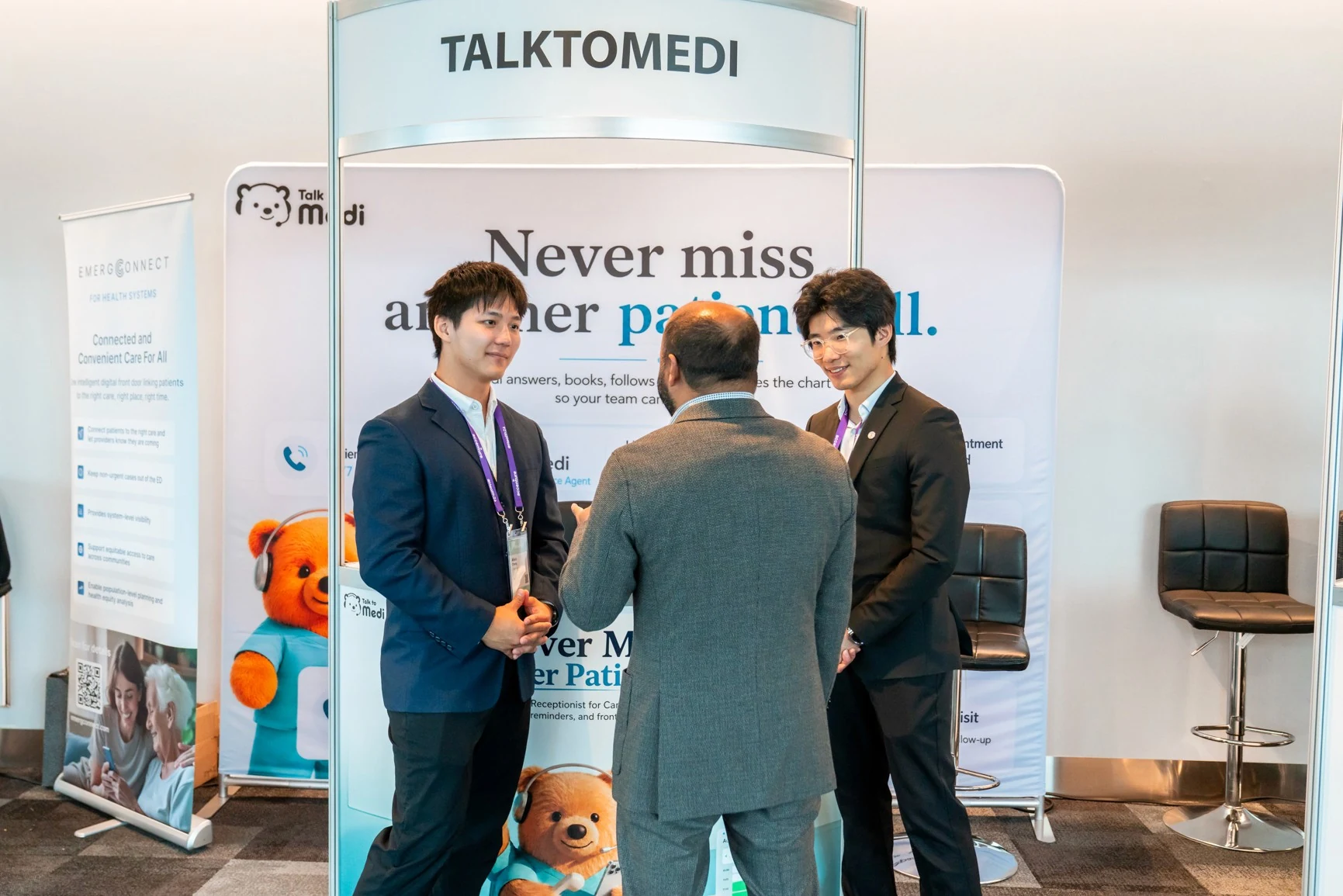
A year ago, TalkToMedi’s relationship with the e-Health Conference began from outside the room.
Our founder, Kino Song, did not have a conference pass. He spent time near the venue, speaking with people between sessions and trying to understand where a young company focused on clinic communication could contribute to Canada’s digital-health system.
This year, we returned with a booth and a team. More importantly, we returned with experience from real clinic workflows and more precise questions about patient access.
e-Health recently published a feature about that journey. The story matters to us because it captures more than company growth. It reflects a change in responsibility. As technology reaches more clinics and patient interactions, the standard for evidence, reliability and accountability has to rise with it.
What this recognition means - and what it does not
The e-Health Conference is an established forum for Canada’s digital-health community. It is co-hosted by Digital Health Canada, Canada Health Infoway and the Canadian Institute for Health Information, and brings together health professionals, patient representatives, technology teams and system leaders.
Being featured on its platform is meaningful independent recognition that TalkToMedi’s experience is relevant to that conversation.
It is not a certification, an audit of our technology or an award naming TalkToMedi the market leader. We should not describe it that way. Trust in healthcare is weakened when recognition is stretched beyond what the source actually says.
The stronger interpretation is simpler: an established Canadian digital-health platform considered TalkToMedi’s operating journey worth sharing, and connected that journey to a larger question facing the sector. How should healthcare technology be built so that it fits the people, systems and decisions already responsible for care?
Learn more about the e-Health Conference and its hosts.
A natural voice is only the beginning
Medical voice AI is often demonstrated through conversation. A caller asks a question, the system understands it and the response sounds natural. That is useful, but it is not enough to make the product useful inside a clinic.
The operational questions begin after the first sentence:
Does the system know which appointment types a caller is eligible to book?
Can it work with the clinic’s actual schedule and communication rules?
What happens when a routine booking request turns into a symptom question?
Does a completed action reach the clinic’s source system?
Can staff see what happened and correct it when needed?
Is there a clear human path for urgent, sensitive or uncertain requests?
This is why we think about MEDI as part of patient-access operations, not simply a voice interface. Calls, text reminders, booking, intake, follow-up and staff handoff are connected parts of one workflow. A polished conversation has limited value if it creates another voicemail, another disconnected note or another task the front desk must reconstruct.
Our approach to EMR-connected medical call automation starts with the action and its boundary: what information the workflow may use, what it may complete, where staff approval remains required and how the outcome is recorded.
Building for Canadian healthcare is not a localization setting
Canada is not one uniform clinic market. A family practice, physiotherapy clinic, pain clinic, cardiology practice and pediatric clinic can use different systems, staffing models and rules even when they operate in the same city.
Provincial requirements and organizational responsibilities matter. So do language, accessibility, patient preference and the reality that many clinics run on a combination of an EMR, a phone system, a fax workflow and local processes that have developed over years.
A generic script cannot safely absorb that complexity. The implementation has to begin with workflow discovery:
Identify the requests creating the most patient and staff friction.
Separate routine administrative actions from clinical or uncertain decisions.
Map the source system, permissions and owner for every outcome.
Test normal calls alongside edge cases, outages and failed identity checks.
Review corrections, escalations and patient feedback before expanding the scope.
That is also why privacy should not be reduced to a badge in a headline. Canadian clinics need to examine the actual data flow, roles, safeguards, retention, access, contracts and configuration that apply to their deployment. The important question is not whether a vendor can repeat the name of a law. It is whether the clinic can understand and govern what happens during a real patient interaction.
Patient access is where healthcare voice AI has to prove itself
Many clinics do not have a shortage of patient demand. They have an access bottleneck between the patient’s intent and the clinic’s ability to respond.
A patient calls to book, cancel, ask for directions, confirm a referral or understand the next administrative step. If the line is busy, the request can become a voicemail, a repeat call or a delay. Staff then manage the original need and the backlog it created.
Reducing missed calls is therefore not just about answering more quickly. The patient needs a clear next step, and the clinic needs an accountable outcome. Some requests can follow an approved automated workflow. Others should reach staff with the caller’s context preserved. Clinical judgment remains with the care team.
TalkToMedi has published de-identified case studies so buyers can inspect what that distinction looks like in practice. One follows a high-volume family practice using an AI phone system. Another examines appointment booking during the first month of an AI front-desk deployment. These are company-reported deployment results, not promises that every clinic will achieve the same outcome. Their value is in the defined timeframe, workflow and measures that other clinics can question and compare with their own baseline.
Five questions clinics should ask any medical voice AI company
Recognition can help a clinic decide which companies deserve a closer look. It cannot replace diligence. Before deploying healthcare voice AI, we believe a clinic should ask five practical questions.
1. What work does the system actually complete?
Separate answering from resolution. A transferred call, captured message, completed booking and staff escalation are different outcomes. The vendor should show each one.
2. How does the workflow connect to the clinic’s source of truth?
Ask what the system may read and write, which integration or staff queue receives the result and what happens when that connection fails.
3. Where does automation stop?
Clinical, urgent, sensitive and uncertain situations need explicit boundaries. A strong handoff is a product capability, not an admission of failure.
4. Can the clinic review the real privacy and security controls?
Review the actual deployment rather than relying on a general claim. Follow data from the call through transcription, processing, storage, staff access, retention and deletion.
5. Which measures will determine whether the rollout expands?
Track resolved requests, booking completion, repeat calls, staff correction time, escalations and patient feedback. Compare those measures with a defined pre-launch baseline. Call volume alone does not show whether access improved.
These questions are central to AI reception in family practices, but the same discipline applies across specialties. The workflow should reflect the clinic rather than forcing every clinic into the same script.
From listening at the edge of the room to contributing evidence
The part of the e-Health story we value most is not the booth. It is the change from trying to understand the conversation to being responsible for contributing something useful to it.
For TalkToMedi, that contribution should include more than product announcements. It should include transparent implementation methods, bounded claims, clinic-specific evidence and honest accounts of what still requires human judgment.
Independent coverage can open the door to trust. The work that follows determines whether that trust is deserved.
We are grateful to e-Health for sharing the TalkToMedi story and for creating a place where start-ups can learn directly from the people delivering and improving healthcare across Canada. We will continue using those conversations to build medical voice AI around real patient-access needs, real clinic systems and real operational accountability.
Read the original e-Health feature. If your clinic is evaluating patient-access automation, review your current workflow with TalkToMedi.