For clinics considering an AI front desk, the biggest unknown is usually whether patients will actually use it. Answering the phone is easy to demonstrate. Completing the job a patient called to do is the harder test.
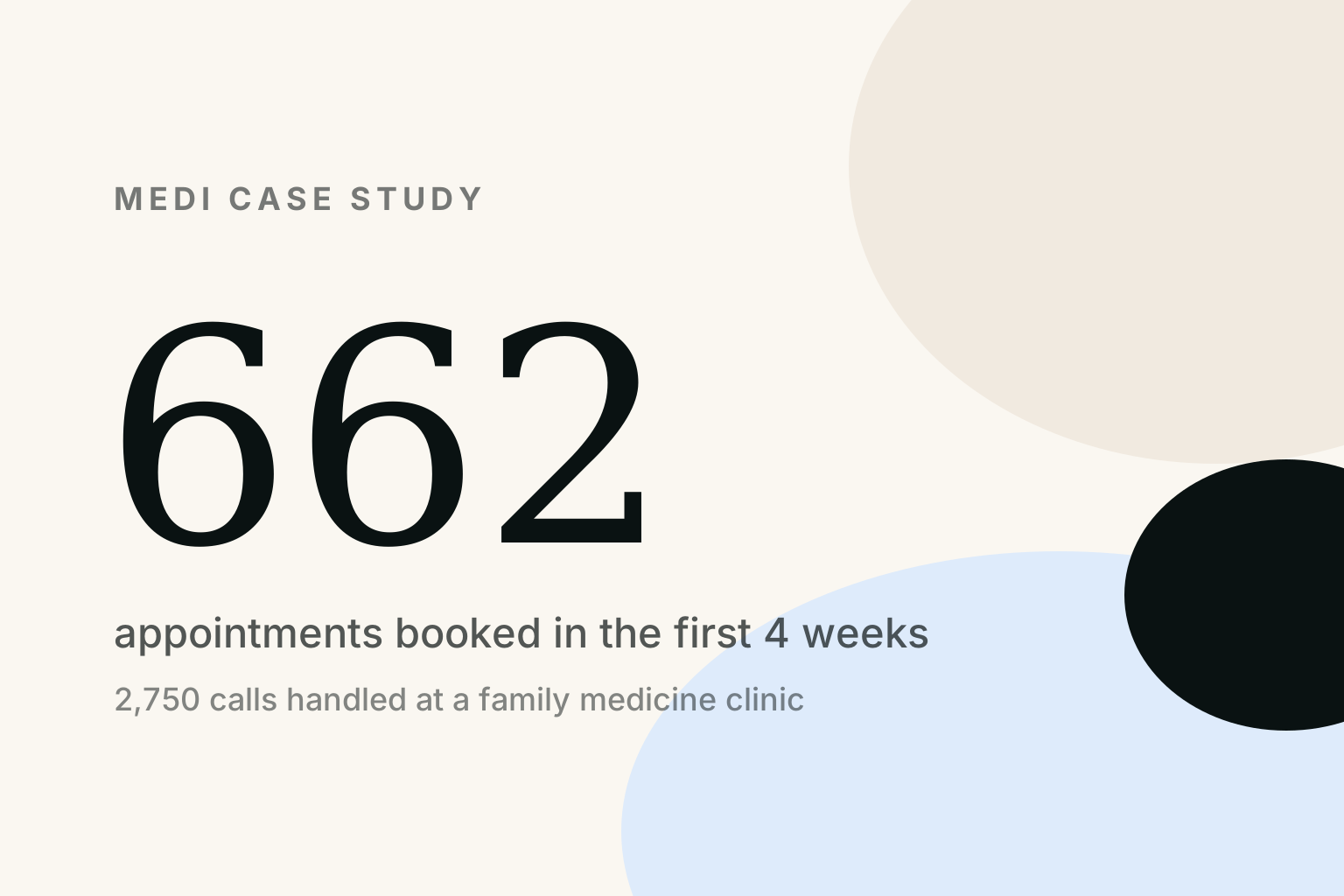
At one family medicine clinic, Medi settled the question inside a month. Over its first 33 active days it handled 2,750 patient calls and booked 662 appointments, which works out to roughly one booking for every four calls.
The clinic saw meaningful performance almost immediately, including an early spike day when Medi handled 293 calls on its own. Across the full first month, 55% of calls were completed without any staff involvement, and callers who phoned in wanting an appointment left with one nearly half the time.
Clinic profile
This deployment covered a family medicine clinic in its first 33 active days with Medi, and appointment booking was the primary workflow from day one. Booking mattered more here than at most practices because it made up about half of the clinic’s call demand, so the deployment would stand or fall on whether patients trusted an AI front desk enough to finish scheduling with it.
What this case study shows
In its first 33 active days, Medi booked 662 appointments for this family medicine clinic. It handled 2,750 patient calls along the way, converted 48% of booking-intent calls into scheduled appointments, and completed 55% of all calls without staff needing to step in.
Medi booking impact at a glance
This case study is about conversion: what happens when patients call an AI front desk and try to complete a real scheduling task.
The strongest signal was patient adoption. In its first 33 active days, Medi booked 662 appointments, meaning roughly one in four total calls became a scheduled appointment.
The headline numbers held up across the whole ramp. Medi handled 2,750 patient calls on a live family medicine phone line and turned 662 of them into booked appointments. Of the callers who phoned in specifically to book, 48% ended the call with a confirmed slot. More than half of all calls, 55%, finished without the front desk stepping in at all, and one early high-volume day saw Medi absorb 293 calls.
Supporting metrics tell the same story. The average call length was 1 minute 25 seconds, and caller sentiment stayed at 83% positive through the ramp.
Medi stands out for appointment-heavy clinics because it does more than answer and route calls. It can understand booking intent, offer available appointment times, complete the scheduling workflow, and send confirmation to the patient.
If your front desk spends its day on repetitive booking calls, if patients sit on hold to schedule routine visits, or if you are weighing whether patients would even adopt an AI receptionist, this deployment is a useful reference for how quickly the answer can show up.
Background: appointment demand was the real test
For a clinic, a call answered is not always a problem solved.
A patient may still need to book an appointment, clarify whether the visit is in person or by phone, choose from available times, confirm details, and receive follow-up instructions. If the AI only captures a message or routes the caller elsewhere, staff may still have to complete the work later.
That is why appointment conversion is the right test for this case study. Answering calls only helps if the scheduling work behind them actually gets done.
When booking is half of what the phone rings for and conversion is poor, the effects compound. Patients hold for routine scheduling while staff walk through the same availability script dozens of times a day. Calls that could have been resolved in two minutes turn into voicemails and callback lists, the schedule fills more slowly than demand arrives, and the people at the desk have less attention left for complex calls and the patients standing in front of them.
Primary care access is already under pressure. Reporting in The Wall Street Journal has pointed to operational friction, from phone hold times to confusing follow-up processes, as part of why scheduling care can feel frustrating for patients. Appointment booking is only one part of clinic operations, but it is among the most repetitive and measurable parts of the front-desk workflow.
For this clinic, booking represented about half of call demand. Medi’s 48% booking-intent conversion rate mattered because it meant callers were completing the task itself, start to finish, with the AI.
Challenge: a new AI front desk had to prove patient adoption
The clinic was testing something more specific than whether Medi could answer calls: whether patients would trust the workflow enough to finish booking.
That distinction matters. A phone automation system can look useful on paper and still fail if patients abandon the call, ask for a staff member every time, or complete only simple informational requests.
The early adoption signals were strong. Within those 33 days patients pushed 2,750 calls through the system and finished 662 bookings, and Medi carried more than half of the volume unaided, including that 293-call day shortly after launch.
The combination is what makes the case convincing. The clinic saw call volume, booking completion, staffless handling, and positive sentiment during the initial ramp period, all at once.
Solution: how Medi converted calls into booked appointments
Medi was deployed as an AI front desk on the clinic’s phone line. From the patient’s perspective, the workflow was straightforward: call the clinic, say what kind of appointment they need, hear available times, choose a slot, confirm the booking, and receive a text confirmation.
Behind that experience sat a defined sequence. Medi answered without making the caller wait for a free staff member, then worked out what the call was for: a new booking, a reschedule, a question, or something that belonged with the team. When the caller wanted an appointment, it offered suitable open times from the clinic’s scheduling setup, confirmed the chosen slot along with details such as whether the visit was a phone consult, completed the booking in the clinic’s scheduling system, and texted a confirmation so the patient hung up with a record in hand.
Anything that fell outside the approved workflow, or needed staff review, was routed to a person instead of being forced through automation.
Example: a telephone appointment booked in under two minutes
In one de-identified example, a patient called to book a telephone consult.
Medi offered available morning times, confirmed the patient’s choice, booked the appointment through the clinic’s scheduling workflow, clarified that the physician would call the patient, and sent an SMS confirmation.
The entire interaction took under two minutes, and that is the everyday win. Not every AI healthcare story needs a dramatic headline. Sometimes the most valuable result is a routine patient request completed cleanly, hundreds of times a month.
Staff feel it as fewer repetitive booking calls. Patients feel it as faster access, and clinic leadership gets its proof within weeks instead of quarters.
Impact: what 55% staffless handling means during ramp
Medi handled 55% of calls without staff involvement during the first 33 active days. In a 2,750-call sample, that represents about 1,513 patient calls completed without front-desk staff needing to step in.
That is important because early deployments are often judged on adoption risk. Clinics want to know whether patients will engage with the AI, whether common workflows will complete correctly, and whether staff will actually feel relief.
Averaged out, the ramp came to about 83 calls handled and 20 appointments booked per active day, with roughly 1,513 calls closed before anyone at the desk had to touch them.
The average call length was 1 minute 25 seconds, but the point is not that calls were rushed. Routine booking conversations can simply be short when the system understands the request, presents availability, confirms the slot, and completes the workflow in one call.
Manual booking vs. Medi AI front desk
The difference from manual booking shows up at every step. On a traditional line the patient waits on hold, a staff member works out what they need, reads slots aloud from the schedule, types the appointment in, and repeats the details back, and that person is tied up for every single booking call.
With Medi on the line, the call is answered at once and the booking intent is picked up in conversation. Available times are offered directly, the appointment is written into the clinic’s scheduling workflow, and the confirmation arrives by text, with staff pulled in only when a call genuinely needs escalation or human review.
What clinics should take from this case study
This case study shows that the first month of an AI front desk deployment can produce meaningful appointment volume when the workflow is focused on a high-demand task.
The practical lessons travel well. Adoption counts for more than novelty: patients used Medi to book 662 appointments in the first 33 active days. Booking conversion is a sturdier proof point than call answering alone, and a 48% booking-intent conversion rate carries real weight when booking is about half of call demand. Staffless handling matters during ramp, with roughly 1,513 calls never reaching the desk, and none of it came at the cost of experience, since caller sentiment held at 83% positive.
For practices looking to modernize phone operations, that kind of fast ramp matters. It gives clinic leaders proof that AI can start contributing to real appointment volume within weeks.
Sources and notes
Medi internal call analytics for this de-identified family medicine clinic deployment, covering the first 33 active days.
Primary-care access and scheduling context, reported by The Wall Street Journal: Seeing a Doctor Doesn't Have to Be So Frustrating.
Scheduling operations context from Managing Access to Primary Care Clinics Using Robust Scheduling Templates: arXiv:1911.05129.
Patient agency and AI adoption context from IAC: A Framework for Enabling Patient Agency in the Use of AI-Enabled Healthcare: arXiv:2111.04456.
Real-world conversational medical AI context from Conversational Medical AI: Ready for Practice: arXiv:2411.12808.
FAQ
How long does it take to deploy an AI front desk for appointment booking?
Deployment time depends on the clinic’s phone system, scheduling workflow, appointment types, and integration requirements. The important signal in this case study is that Medi reached meaningful appointment-booking volume within its first 33 active days, handling 2,750 calls and booking 662 appointments.
Will patients actually book appointments with an AI receptionist?
Yes, if the workflow is clear and useful. In this case study, about 24% of all calls handled by Medi became booked appointments, and 48% of booking-intent calls converted into scheduled appointments.
What appointment types can an AI front desk book?
An AI front desk can support appointment types that follow approved clinic rules, such as telephone consults, routine visits, follow-ups, or other predefined scheduling workflows. More complex requests should be escalated to staff instead of forced through automation.
What happens if the patient asks for something outside the booking workflow?
The AI front desk should escalate when a request does not fit the approved workflow, requires staff review, or needs human judgment. This protects the patient experience and keeps automation focused on tasks it can complete reliably.
How should clinics measure whether AI appointment booking is working?
The most useful metrics are booking-intent conversion, total appointments booked, staffless handling rate, caller sentiment, average call length, escalation rate, and appointment confirmation completion. For this clinic, the strongest proof points were 662 appointments booked, 48% booking-intent conversion, and 55% staffless handling.
Conclusion
This family medicine clinic did not need a long ramp before Medi started contributing. In its first 33 active days, Medi handled 2,750 calls, booked 662 appointments, converted 48% of booking-intent calls, and handled about 1,513 calls without staff involvement.
The strongest signal was patients using Medi to complete the thing they called to do: book care.
To see how many booking calls Medi could complete for your clinic, book a live walkthrough.
See how MEDI supports clinic-defined appointment scheduling workflows.