
A live medical answering service gives patients a person to speak with when the clinic cannot answer. An AI medical receptionist can handle defined administrative conversations and, where the clinic's systems and permissions support it, complete actions such as booking or rescheduling. A hybrid approach uses automation for approved requests and people for exceptions.
The useful comparison is the work each model finishes. A call answered politely may still leave your receptionist with a message, a callback and a booking to complete. Start with the patient’s request and follow it until the next step is done.
TalkToMedi provides an AI front desk, so we have a commercial interest in this decision. This guide compares operating models rather than ranking providers. The questions apply equally to an AI vendor, a live service and your existing team.
What a medical answering service actually includes
“Medical answering service” can describe quite different arrangements. Some services collect a message and notify the clinic. Others follow an on-call roster, transfer calls, schedule appointments or provide additional support under an agreed scope.
It would be unfair to assume that every live service only takes messages. For example, AnswerLive's own medical-service page describes appointment scheduling, call routing and on-call support. What matters is whether the proposed service can perform those tasks in your clinic’s systems, under your rules, during the hours you need.
An AI receptionist also needs that definition. “Understands appointment requests” might mean it records a request for staff. “Books appointments” should mean the correct appointment is created in the agreed system and the patient receives a clear confirmation. Those are different deliverables.
Before comparing prices, write a one-sentence description of the job: “Handle overflow requests to move an existing follow-up with the patient’s usual provider, and route every exception to reception.” A specific scope produces a much more useful proposal than “cover our phones.”
Compare the same call from beginning to end
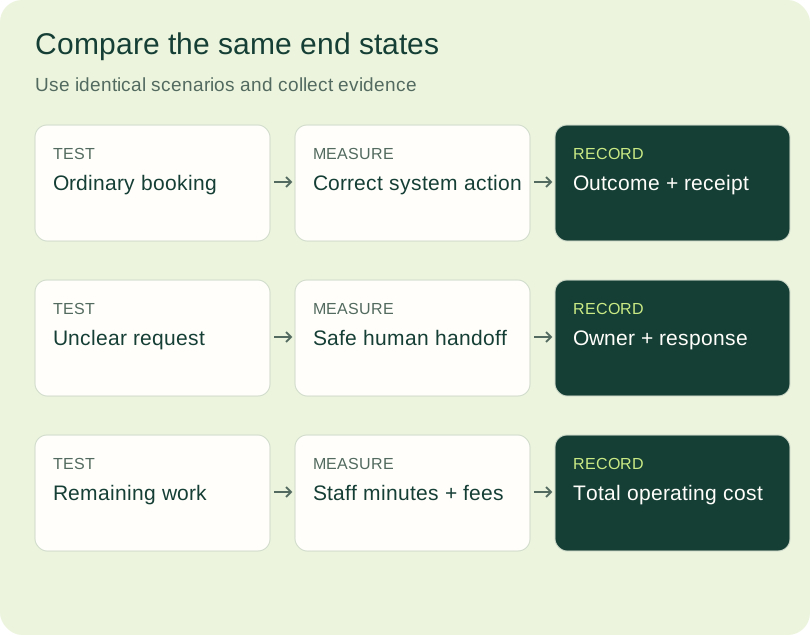
Consider a patient calling at 6:15 p.m. to move a follow-up from Tuesday to Thursday. A useful outcome requires the right patient, provider, appointment type, duration and location. The original appointment must also be handled correctly. If Thursday is unavailable, the patient needs a truthful next step.
Use the same scenario with every provider. Then repeat it with an appointment that cannot be changed, an unavailable schedule connection and a request for a person. These are buying tests, not claims that one model will always perform better.
| Question | Live medical answering service | AI medical receptionist | Hybrid coverage |
|---|---|---|---|
| Who speaks with the caller? | A service agent | A configured AI voice agent | AI or a person, according to routing |
| Can an appointment be completed? | Depends on system access, training and contracted scope | Depends on integration, permissions and configured rules | Depends on which team owns each action |
| What happens with an exception? | The agent follows the agreed escalation path | The agent should stop or hand off according to approved rules | The exception moves to the designated human team |
| What can remain for clinic staff? | Callbacks, messages and actions outside the service scope | Review, failed actions and requests outside the automation scope | Handoff review and tasks outside either scope |
| What needs monitoring? | Accuracy, staffing, queue delays and message delivery | Accuracy, failed actions, routing and configuration changes | Both systems and the handoff between them |
No table can establish fit by itself. Ask the provider to show the final appointment or staff task, not just play the conversation. Check whether staff must re-enter details or call the patient again to establish what happened.
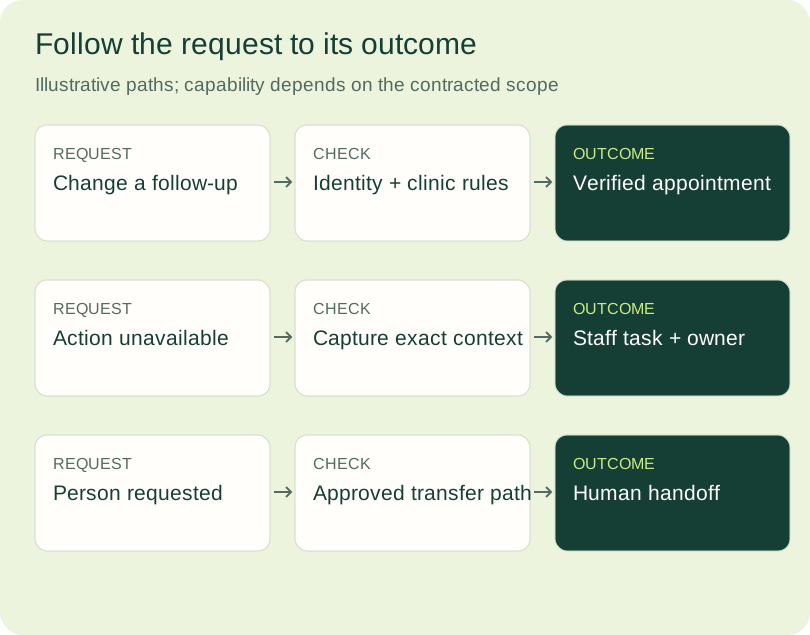
How MEDI applies your clinic's booking rules
MEDI uses your clinic's appointment types, visit lengths, provider and location rules. This helps patients find an appointment suited to their request and keeps the clinic's instructions part of the conversation. Available scheduling actions depend on your system and configuration.
A follow-up request can require a particular visit type and the patient's usual provider. Bring those instructions to the demonstration and ask MEDI to find a suitable appointment. Review the next step the patient receives and the appointment shown in the clinic's schedule.
Consider a hypothetical clinic where a patient asks for a follow-up after work with their usual provider. The demonstration should show a suitable time being offered, the patient's choice and the confirmed appointment in the clinic's schedule. This is an illustrative scenario, not a real patient's record or a customer result.
During your pilot, verify the appointment's provider, visit type, time and location in the EMR to confirm that it matches your clinic's rules.
Available appointment actions depend on your EMR and clinic configuration. Confirm the supported booking, cancellation and rescheduling workflow during your demo.
A live answering service with trained agents and appropriate access can also enforce scheduling rules. Compare how each service applies your policy, proves the permitted action and handles an unsupported request.
When each model makes sense
A live service can be a good fit when the required job is largely human conversation, message capture or on-call coordination. It may also suit a clinic whose workflows change frequently or whose systems cannot expose the actions an automated agent needs. Confirm the service's availability, agent training and fallback arrangement for your actual call mix.
AI reception can be a good fit when a meaningful share of requests follows clear administrative rules. Examples include moving an eligible follow-up, explaining approved opening hours or collecting the fields needed for a routine request. Start with a workflow staff can describe consistently, then test the awkward cases that make it difficult in practice.
A hybrid model is useful when those conditions coexist. You might automate routine overflow calls while keeping a live service for a defined after-hours escalation path. Give each request a clear owner: if a booking fails, who receives the task, how quickly do they act, and how does the patient know what comes next?
This is a separate buying decision from documentation software. If the main problem is physicians finishing charts after clinic, read our AI medical receptionist versus AI medical scribe comparison before choosing a phone workflow.
Budget for the work left behind
A low monthly fee can become expensive if it creates a second queue. Include the provider's quoted charges, setup, phone routing, integration work, staff oversight and the time needed to finish or correct requests. Ask how usage, transfers, additional numbers and support are billed; obtain the answer in writing for your proposed scope.
Compare costs using the same workload and observation period. A useful measure is total coverage cost divided by correctly completed eligible workflows. Report captured messages and correct transfers separately, because they serve different purposes and can still be valuable.
For an illustrative clinic with 400 eligible requests in a month, a service that correctly completes 240 has a 60% eligible completion rate. If total coverage and follow-up costs are C$1,800, the cost is C$7.50 per completed eligible workflow. These numbers are a worked example, not a provider quote or a TalkToMedi result.
Recovered staff time is useful capacity. It becomes cash savings only when a real expense changes. Extra appointments also need scrutiny: a booking has no incremental financial value if it simply moves demand that would have booked anyway. Use the medical call automation ROI calculator to make those assumptions visible.
Test the human handoff as carefully as the booking
A patient may ask to speak with reception, disclose something outside the approved scope or need clinical help. A service needs a practical route for each situation. Agree what it says, where it sends the call, what context accompanies it and what happens if nobody answers.
MEDI supports live transfers, configured message capture and post-call SMS. Agree how each path works for your clinic, including the staff destination and the patient's next step when a line is unavailable.
Administrative automation should not be purchased on the assumption that it independently makes medication or treatment decisions. Keep clinical questions within the clinic's approved human pathway. Also test ordinary operational failures: an unanswered transfer, an unavailable schedule and a patient who cannot complete the requested verification.
Privacy review belongs in the same process. Draw where recordings, transcripts and messages travel; establish retention, access, deletion and incident responsibilities. A badge on a website cannot answer questions about your deployment. Our Canadian clinic procurement checklist provides a fuller review structure.

A decision checklist for your next vendor call
Take six questions into the conversation and ask for a demonstration or document for each answer:
- Which of our five most common call reasons can you complete, capture or route?
- Can you demonstrate the resulting appointment or task in our proposed system?
- Which provider, duration, location and booking restrictions will you enforce?
- What happens when a patient asks for a person or a transfer is unanswered?
- What charges and clinic staff work are included in the proposed operating cost?
- How will we review errors, change rules and pause the workflow?
A useful pilot has a small scope, a baseline and a decision date. Measure correct completions, handoff quality, repeat calls, staff rework and patient feedback. If the pilot generates more cleanup than it removes, change the scope before increasing volume.
See the workflow with your clinic's rules
TalkToMedi's medical AI receptionist supports appointment booking and changes, intake capture and staff routing using clinic-defined workflows. The actions available depend on the system, permissions and configuration. A limited voicemail pathway may be another starting point; see smart voicemail and patient SMS.
Book a workflow demo with one routine call, one booking exception and one human handoff. The most useful outcome is a clear view of what the patient receives, what appears in your system and what your staff still need to do.
Sources and further reading
Product information reviewed October 4, 2026. Confirm the available actions and enabled policies for your clinic's configuration.
- AnswerLive: answering services for doctors — a first-party example showing why live-service scope must be verified.
- TalkToMedi: medical AI receptionist and integrations — current product scope and configuration limits.
- TalkToMedi: trust, privacy and safety — documentation and workflow review questions.