
Picture a patient realizing after dinner that they cannot attend tomorrow's appointment. They call the clinic, leave a voicemail and hope someone hears it before the visit. When reception opens, that message is one of several waiting while patients are already arriving at the desk.
The patient had a simple administrative problem. By morning, it may involve listening to a message, finding the appointment, calling back and trying to use the opening in the schedule. After-hours phone coverage affects both sides of that experience: whether the patient can make progress and what reception inherits the next day.
Voicemail can work well when the clinic has a reliable callback process. An AI front desk becomes worth considering when many evening callers need help with routine questions or appointment changes that the clinic can authorize it to handle.
Think through the evening call from the patient's side
A patient may call after work because that is the first time they have a quiet moment. Someone else may need the address for a morning visit or want to arrange a follow-up without leaving their own workplace during clinic hours.
A recording can provide general instructions and collect a message. An interactive service can ask a follow-up question and, where the clinic's system supports it, carry out a permitted administrative action. That difference matters most when it prevents another round of phone tag.
For example, a patient asking to move an appointment needs a clear ending. If the appointment changed, they should receive the new details. If staff still need to review the request, they should know the existing appointment has not automatically changed. The closing explanation is part of the service patients experience.
Where each option makes sense
| What happens in your clinic | Voicemail may be sufficient when… | An AI front desk may be useful when… |
|---|---|---|
| General questions arrive after closing | The greeting answers the common questions | Callers need different answers or clarification |
| Patients ask to book or change visits | Staff can return calls promptly and patients are easy to reach | Supported appointment actions can be completed while the patient is available |
| Many messages need a care-team response | Messages reach an accountable team reliably | The service can organize the administrative information and explain the next step |
| The morning queue overwhelms reception | Staffing or callback changes can address the backlog | Routine evening work can be completed before the desk opens |
Some clinics need a live answering service or a combination of options. The right choice depends on what callers need and what the service is contracted and equipped to do. The answering-service comparison examines those arrangements.
Give every caller an understandable next step
A useful after-hours service should leave the patient knowing whether their request is finished, waiting for the clinic, or needs another route.
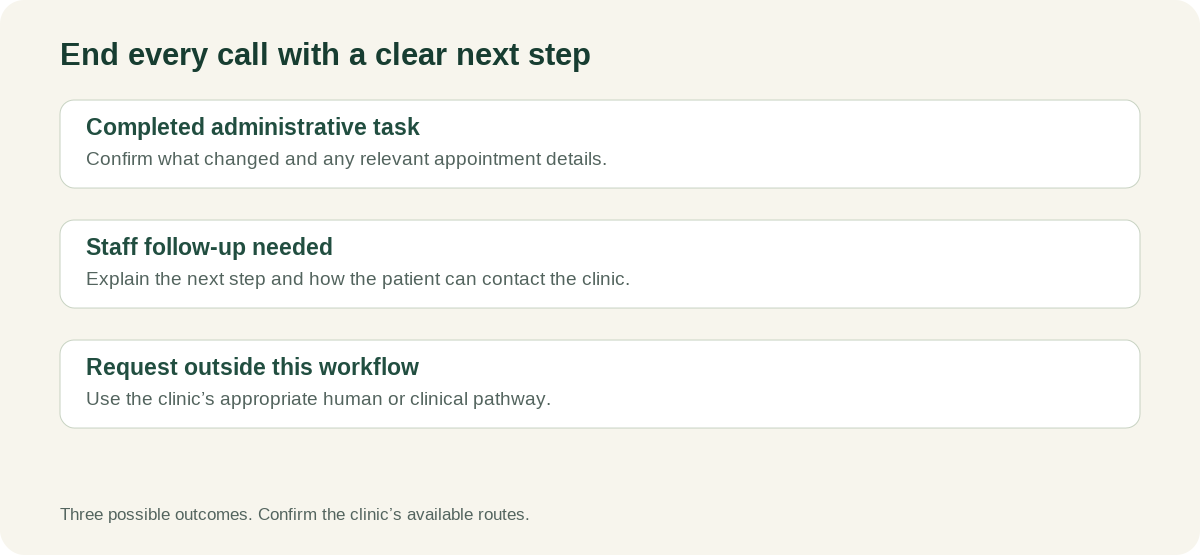
For a completed booking, repeat the date, time, provider and location. For a staff message, explain when the clinic normally reviews that type of request, using a timeframe it can actually support. A caller asking a clinical question needs the clinic's approved instructions and route to appropriate help. An administrative AI front desk should not be presented as an emergency service or a source of independent medical advice.
Patients should also have a clear way to ask for staff assistance. A service can be useful without being able to finish every conversation by itself.
The morning queue should become easier to work through
Reception needs to see what happened overnight without listening to every conversation from the beginning. An appointment that was successfully changed belongs in a different situation from a request still awaiting a decision.
Go back to the patient who called after dinner. Imagine they ask to move a routine Tuesday appointment to Thursday. With voicemail, they leave a message and reception sees a request to review in the morning. The caller still needs to hear from the clinic about whether the appointment can move.
If the clinic authorizes that change and the service completes it, the patient can hear, “I've moved your appointment to Thursday at 3 p.m. at the same clinic.” Reception can see the Thursday visit and the completed change in the schedule. If the change needs staff approval, the caller hears, “I've sent your request to reception. Your Tuesday appointment is still on the schedule,” and the record goes into the morning queue. The patient and reception can then act on the same information.
Agree where overnight messages appear and who checks them. Test a day when the usual receptionist is away. Also test what happens when a message cannot reach its usual destination. Those practical details determine whether the service fits the clinic's working day.
Keep patients' information current
Holiday hours, a physician's absence or a change of location can make yesterday's correct answer unhelpful today. Someone at the clinic should approve updates and know how to request them. Important changes should be tested before patients rely on them.
The same care applies to information handling. Even a call about an appointment can include personal health information. Review what is recorded, who can access it and how long it is kept with your clinic's privacy lead. TalkToMedi's trust resources are a starting point for that discussion.
Judge the service by what patients and staff experience
After a trial, ask reception whether fewer routine callbacks are waiting and whether the remaining messages are easier to act on. Ask patients whether they understood what happened. Check that appointments were correct and that requests needing people reached them.
A simple before-and-after review can record overnight requests, completed appointment actions, staff callbacks and correction time. The missed-call worksheet provides a place to collect aggregate figures. For a broader look at coverage during the working day, read how to reduce missed calls at a medical clinic. Use similar periods and note differences in holidays, staffing and demand. Agree what your phone system counts as an answered call and what the clinic counts as a completed request before comparing results.
TalkToMedi’s MEDI virtual receptionist supports clinic-defined administrative calls and available appointment workflows through its after-hours service. A focused pilot can show which of those actions help your clinic. Bring an example of your morning voicemail queue, using made-up patient details, and walk through what each caller should receive instead.
About this comparison
The examples are illustrative. Actual actions depend on the clinic's medical AI receptionist setup, available connections and approved instructions. This comparison does not predict a clinic's savings or appointment outcomes.